


Final 2026 Open Enrollment Report: Broker/Agent Assistance (Part 10)
Fri, 03/27/2026 - 4:07pm
This is the first year that the Centers for Medicare & Medicaid Services (CMS) has included data on how many ACA Open Enrollment Period enrollees selected policies with the help of certified insurance broker, agent or assister (such as ACA Navigators or Certified Assistance Counselors (CACs).
Each year, the Centers for Medicare & Medicaid Services (CMS) makes grant awards to organizations who serve as Navigators in FFM states. Navigators play a vital role in helping consumers prepare applications to establish eligibility and enroll in coverage through the Marketplaces and potentially qualify for an insurance affordability programs. They also provide outreach and education to raise awareness about the Marketplace, and refer consumers to health insurance ombudsman and consumer assistance programs when necessary. Navigators operate year-round—increasing awareness among the remaining uninsured about the coverage options available to them, helping consumers find affordable coverage that meets their needs, and assisting consumers beyond the enrollment process to ensure they're equipped with the tools and resources needed to utilize and maintain their health coverage all year. Navigators must complete comprehensive federal Navigator training, criminal background checks, and state training and registration (when applicable), prior to assisting consumers.
Certified application counselor designated organizations (CDOs) are a vital component of the assister community. In the Federally-facilitated Marketplaces (FFMs), CDOs oversee certified application counselors (CACs) who are trained and able to help consumers seeking health insurance coverage options through an FFM. Organizations that wish to become CDOs designated by the Centers for Medicare & Medicaid Services (CMS) to serve in an FFM must submit an online application and enter into an agreement with CMS. These groups might include community health centers or other health care providers, hospitals, or social service agencies.
Unfortunately, the CMS Public Use File only includes this data for the 30 states hosted via the federal ACA exchange (HealthCare.Gov); the remaining 20 states (+DC) which operate their own exchange are responsible for their own enrollment assistance/navigator programs and thus their data isn't included in this federal report.
Regardless, it's better to have partial data on this front than none at all.
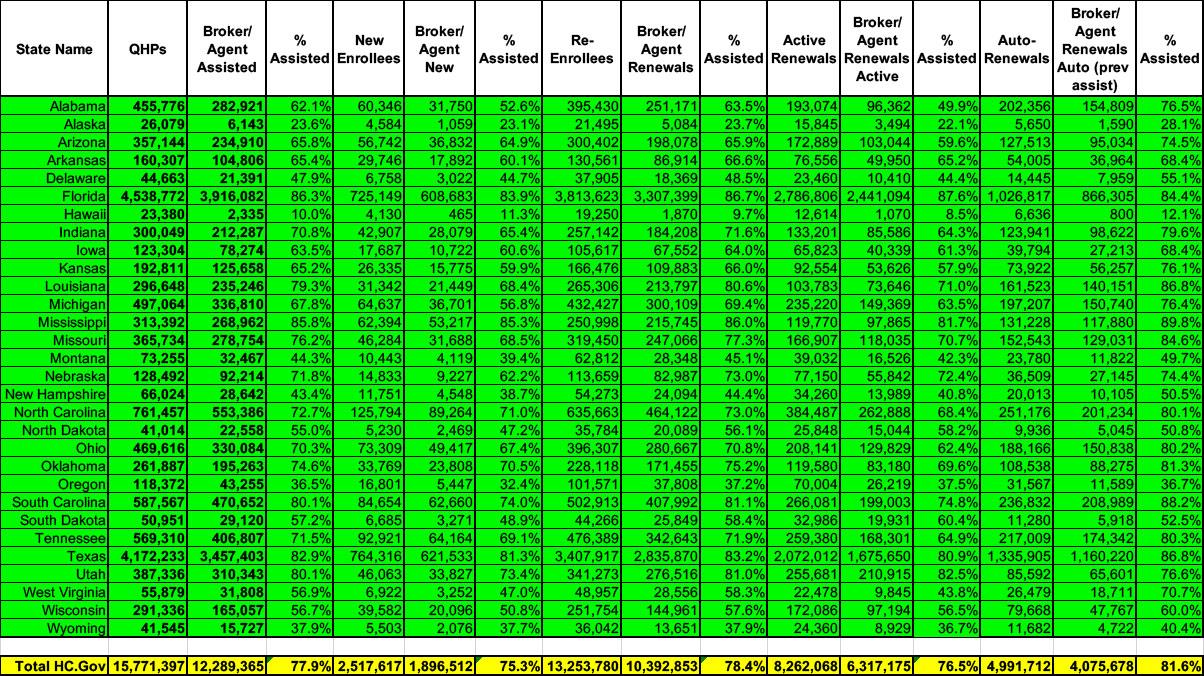
Across the 30 federal exchange states, a whopping 78% of enrollees were assisted by either a private insurance broker or agent. This ranges from just 10% in Hawaii to 86% in Florida.
They've also broke this out to include how many new enrollees were assisted by a broker/agent vs. how many existing enrollees who actively or passively renewed were (in the case of passive auto-renewals, they're counting enrollees who had been assisted by a broker/agent when they originally enrolled in a prior year).
The percentages range widely by state but they don't seem to vary that much from type of enrollee (new, active renewal, auto-renewal).
Advertisement


