Most of the media coverage of the 2026 midterm election two weeks ago has focused on Democrats flipping control of the U.S. House (picking up ~45 seats, although there's a handful of races which still haven't been officially called as of this writing) and the U.S. Senate (picking up 9 additional seats).
When the dust settles, and barring any dramatic last-minute changes via recounts, runoffs, etc., as of January 3, 2027, Democrats are expected to hold 260 House seats (vs. 175 for Republicans) and 56 Senate seats (including two Independents who caucus with Dems) to 44 for Republicans.
Obviously this has important implications for federal healthcare policy in all sorts of ways, but in terms of actual legislation being signed into law, the outcome is far murkier for two simple reasons:
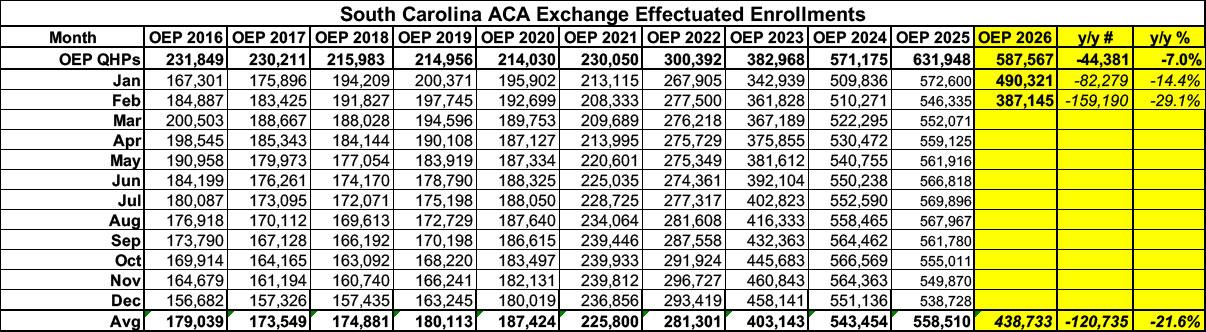
ACA exchange enrollment has dropped by nearly 30% in South Carolina since Congressional Republicans allowed the enhanced federal subsidies to expire at the end of last year.
Initial signups during Open Enrollment were only down 7% vs. OEP 2025...but effectuated enrollment plummeted by 14% in January and a whopping 29.1% as of February vs. a year earlier.
That's nearly 160,000 South Carolina residents who lost coverage in just the first two months of the year...a number which has likely continued to climb since then.
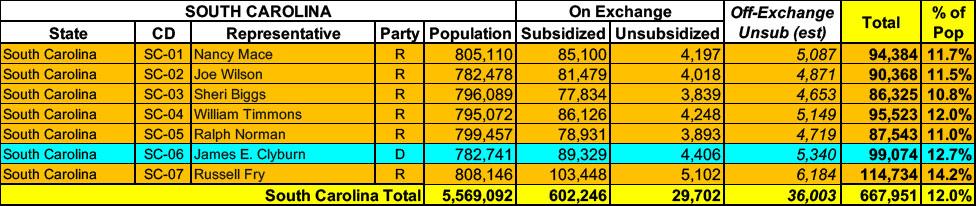
South Carolina has around ~632,000 residents enrolled in ACA exchange plans, 95% of whom are currently subsidized. I estimate they also have another ~36,000 unsubsidized off-exchange enrollees.
The proposed rate change of 27.3% applies to approximately 204,837 individuals. Absolute Total Care’s projected administrative expenses for 2026 are $90.21 PMPM. Administrative expense does not include $17.94 for taxes and fees. The historical administrative expenses for 2025 were $78.35 PMPM, which excludes taxes and fees. The projected loss ratio is 82.6% which satisfies the federal minimum loss ratio requirement of 80.0%.
With the pending dire threat to several of these programs (primarily Medicaid & the ACA) from the House Republican Budget Proposal which recently passed, I'm going a step further and am generating pie charts which visualize just how much of every Congressional District's total population is at risk of losing healthcare coverage.
USE THE DROP-DOWN MENU ABOVE TO FIND YOUR STATE & DISTRICT.
Unfortunately, South Carolina is another state where they don't make unredacted rate filings available, either on the state insurance dept website, the federal Rate Review websiteor the SERFF database.
As a result, I'm limited to unweighted averages for both the individual and small group markets:
It's worth noting that Cigna Healthcare is dropping out of the South Carolina individual market next year, while Aetna is pulling out of the small group market (see below).
Unfortunately, South Carolina is another state where they don't make unredacted rate filings available, either on the state insurance dept website, the federal Rate Review websiteor the SERFF database.
As a result, I'm limited to unweighted averages for both the individual and small group markets:
Individual Market: +3.7%
Small Group Market: +8.9%
UPDATED 11/07/23: A couple of interesting modifications were made in the individual market by state regulators: Blue Cross Blue Shield had their rate hikes cut from 6% to 2.7%; BlueCHoice was cut from 2.1% to essentially flat; Cigna will see a 17.8% average increase instead of their requested 10.5% hike; Molina drops from +6.4% to +4.6%; and Select Health, which had planned on reducing premiums by 4.6 points will instead see an average 1.3% increase. Huh.
The South Carolina Insurance Dept. has posted their final/approved 2023 rate filings for both the Individual and Small Group markets. Unlike the preliminary filings, which they didn't make easily available, the final filings are pretty clear cut. They don't include the enrollment data for each carrier, but most of that is available via the the federal Rate Review website and/or SERFF databases for the indy market. For the small group market, I was only able to find the number of policyholders, not actual enrollees, although that should still give a fairly close approximation to the relative market share.
On the individual market, average rates are going up around 7.3%, which is down a solid amount from the originally-requested average rate hike of 10.4%. The biggest news on SC's indy market is that Bright Health is dropping out (as they are everywhere else as well), while Cigna and Select Health are joining the ACA exchange.
On the small group market it doesn't look like there are any changes to who's participating. The average rate increase is 4.6%, which is actually down a bit from the 5.5% requested average (mostly due to Blue Cross/Blue Choice having their increases shaved down).